Buying guide / Quotations & specifications
Custom bakeware
quotation requirements.
Specify the finished order.
Compare the same scope.
A useful quotation identifies the product, quantity, customization and packing behind the price. Put those details in the first brief so each offer answers the same request.
Get the RFQ template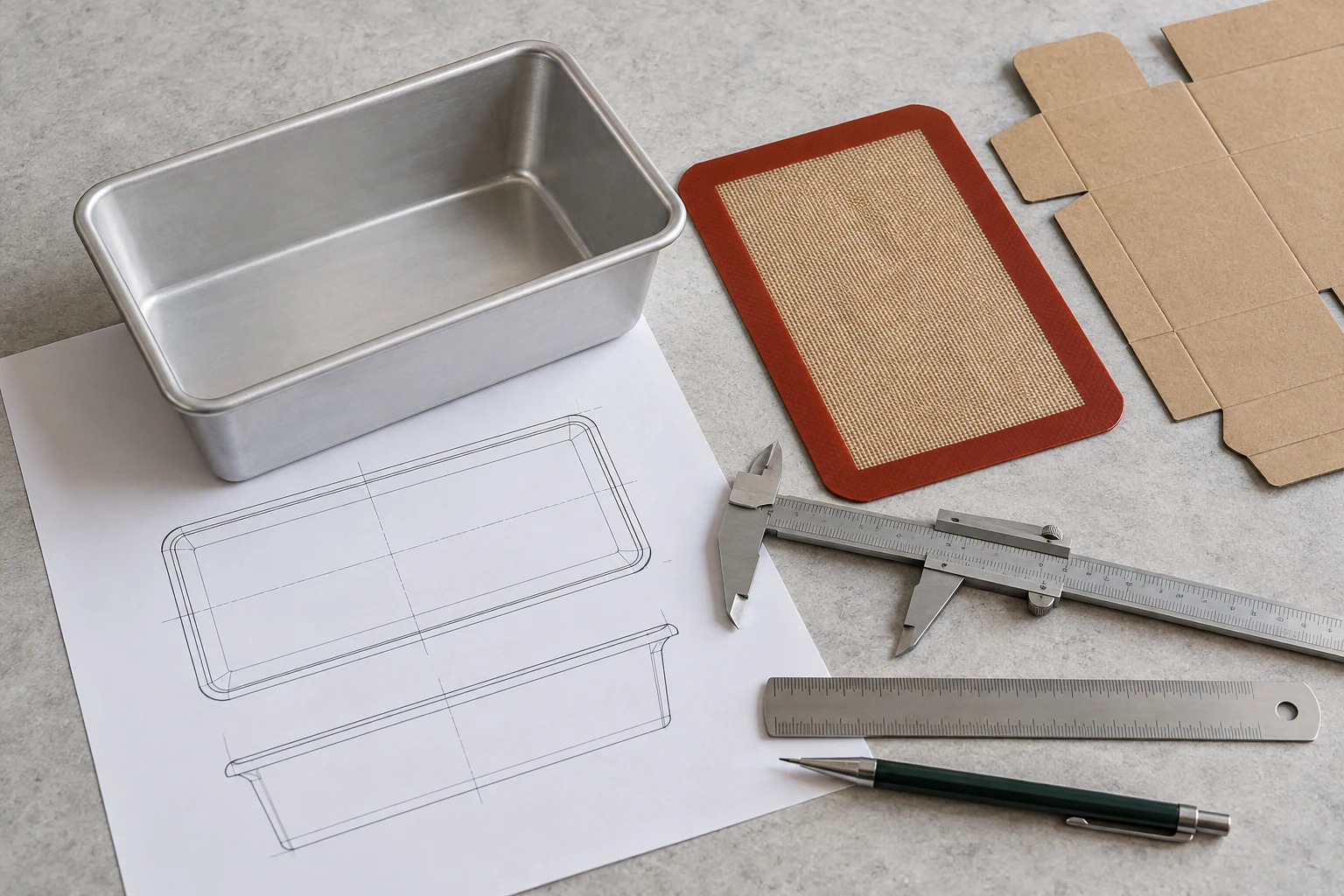
The short answer
A custom bakeware RFQ
needs six clear inputs.
Send a product reference, intended use and market, finished specification, quantity by SKU, branding and packing brief, and sample/delivery requirements. Ask for unit prices and one-time costs separately, with the quotation assumptions identified.
An RFQ is a request for quotation. Its job is to define what suppliers should price. A complete brief makes it possible to compare configurations before approving a sample or placing an order.
01 / The first brief
Give the quotation a defined starting point.
Choose a catalog item, dimensioned drawing or physical sample as the reference. State what stays the same and what changes: logo, color, finished size, construction, tooling or packaging. A reference from another product family is useful for appearance only when its construction is not part of the request.
| Input | What to send | Why it matters |
|---|---|---|
| Product & reference | Catalog item, drawing revision or identified physical sample. | Establishes what the quotation covers. |
| Use & destination | Food or application, operating conditions, cleaning, market and sales channel. | Defines the construction and document review. |
| Finished specification | Material, dimensions, thickness or paper basis weight, and functional details. | Keeps different constructions out of the same price comparison. |
| Quantity & unit | Order quantity by SKU, size and color; pieces, sets, sheets, rolls or kg. | Makes price units and production minimums explicit. |
| Branding & packing | Logo scope, color reference, retail or bulk pack and contents per unit. | Includes the work needed for the finished order. |
| Sample & delivery plan | Samples, approval checks, timing and the requested delivery basis. | Separates development, production and shipment requirements. |
If you have not chosen the material, tolerance or pack, name the unresolved field and ask for a proposed option. Keep required details separate from preferred details so an alternative can be priced without silently replacing your specification.
For a range, use one product line per SKU and configuration. Give the RFQ a revision and date, then use the same version for every comparison. Keep later changes in a revised brief.
Match the request to the decision you are making.
You can begin before every detail is settled. Ask for a budget estimate with its assumptions, then request a configuration quotation after the product and pack are defined. Release production against the approved specification and samples.
| Stage | Buyer inputs | Required response |
|---|---|---|
| Budget estimate | A reference product, intended use, approximate quantity and packing concept. | Identify assumed construction, estimated costs and the open decisions that can change them. |
| Configuration quotation | Defined material, dimensions, quantity split, decoration, pack and delivery basis. | One line per configuration, with pricing, minimums, development charges and deviations. |
| Order release | Approved sample, final drawing, artwork, packing instructions and acceptance criteria. | Confirm the approved revisions, commercial terms and conditions that release production. |
02 / Product detail
Describe construction,
not just appearance.
Write finished dimensions in millimeters and identify the measurement points. Thickness in millimeters, paper basis weight in grams per square meter, and capacity are different measurements. Keep each in its own field.
| Product | Define | Avoid the missing detail |
|---|---|---|
| Metal pan | Metal, thickness in mm, outside footprint, flat base, height, rim, coating or finish. | Add equipment fit and measurement points; a top-view photo does not define rim geometry. |
| Silicone mat | Finished length × width, thickness, reinforcement, border, corners and printed markings. | Include the border in the finished size; state the intended tray and oven cycle. |
| Silicone mold | Overall size, cavity dimensions, layout, capacity method and support requirements. | Separate cavity measurements from overall footprint; identify the intended fill and release. |
| PTFE liner | Coated construction, thickness, cut size or roll width/length, and edge requirements. | Specify a baking-use construction and permitted operating conditions. |
| Paper / disposable liner | Paper type, basis weight in gsm, finished cut, coating or barrier, shape and count. | Identify oven lining or food wrapping; confirm printing and permitted use for that configuration. |
Use a drawing that can be checked.
Include top and side views, units, overall dimensions and the critical inside measurements. Identify cavity geometry, corner radii, holes, handles or rim details when they affect the function. State tolerances for critical features; ask for achievable tolerances where they are unresolved.
For an existing pan, outside dimensions govern equipment fit while the flat base governs liner fit. For a mold, cavity capacity needs a stated measurement method. For paper rolls, specify width, length, core and packing; a roll count without roll length is incomplete.
Set tolerances around the critical fit.
Use the smallest permitted pan base and the largest permitted liner to check minimum clearance. Specify where and under what conditions the dimensions are measured. A tighter tolerance adds a requirement; ask the supplier to confirm the process can meet it before locking the quote.
Illustrative cold-dimension fit check
Pan base: 425 × 300 mm, ±1 mm
Liner: 420 × 295 mm, ±2 mm
Minimum centered edge clearance: 1 mm
The smallest base is 424 × 299 mm. The largest liner is 422 × 297 mm. Subtracting gives 2 mm of total clearance in each direction, or 1 mm per edge with the liner centered.
These are example limits, not an approved pan or liner specification. If the process needs more than 1 mm per edge, revise the finished size or agreed tolerances. Check corner radii, edge construction and fit through the intended bake separately; the length-and-width calculation does not approve those details.
Attach evidence of the reference.
Use numbered photographs with a scale reference and identify the corresponding drawing or sample. Add the surface, edge and underside views that explain the construction. When matching an item, identify the features that must match and those that may change.
Measure the tray using the commercial sheet pan size guide →
03 / Quantity & units
State what one quoted unit contains.
Give the first-order quantity by SKU, size, color and pack. List the price unit explicitly: a piece, set, sheet, roll, pack or kilogram. Add the quantity tiers you want quoted and keep a reorder forecast separate from the initial purchase quantity.
Set quantities, made explicit
1,000 two-mat sets
= 2,000 individual mats
Ask for the price of one complete set, including two specified mats and one retail pack. A quotation for 1,000 loose mats covers half the component quantity and does not include the set packaging.
Keep MOQ tied to its production basis.
A minimum can apply to the product, custom color, marking run or printed pack. Confirm whether it is per SKU, color, size or artwork. Reusable items are commonly discussed in pieces or sets; printed paper may be quoted in sheets, rolls or weight. Request the conversion assumptions when comparing different units.
If a packaging minimum exceeds the first product order, ask how the excess is charged, stored and identified for later use. If items ship together, keep each product’s production minimum and readiness date visible in the quote.
04 / The finished unit
Put branding and packing
inside the quotation scope.
For product branding
Supply vector logo artwork, the intended method, placement, dimensions and color reference. Ask the supplier to identify any method that needs evaluation on the selected material. A printed mat border, molded silicone mark and metal marking involve different work and sample checks.
Identify whether printing or decoration contacts food, enters the oven or goes through washing. State the intended conditions so the proposal and sample review cover the decorated item. Keep a physical color reference for product color; screen images are not a repeatable color standard.
For bulk or retail packing
Specify the contents per sellable unit, packing method and outer dimensions where known. Include sleeves, inserts, labels, instructions, barcodes and assembly. For a kit, attach a component list and packing sequence. Quote bulk bakery packing and consumer retail packing as separate configurations when you need both.
Define units per inner pack and shipping carton. Identify protection from rubbing, crushing, sharp folding or moisture as relevant to the construction. Ask for estimated carton dimensions, gross weight and volume at quotation stage, then confirm the figures on the approved pack.
State who supplies the dieline, print-ready files, care text, product information and barcode. Identify the approval step before printing. Check every inherited logo, QR code and contact line; only the agreed brand and required product information belong in the final artwork.
05 / Samples & acceptance
Quote the work needed to approve the order.
Request samples in the configuration that answers your approval questions. Separate a stock construction sample from a custom decorated sample and a complete pre-production packed unit. State the quantities and the checks required before bulk production.
- Fit and dimensions: drawing revision, measurement points, tolerances and equipment reference.
- Function: intended food or process, operating conditions, release, handling and cleaning.
- Brand execution: logo placement, color reference, print appearance and agreed durability checks.
- Packed unit: contents, artwork, instructions, closure, protection and identification.
Define the destination market and document requirements for the proposed material, construction and intended use. Identify any coating, pigment or printing changes that need review. Request the document scope and related costs separately; a generic certificate description is not a specification for the required evidence.
Ask which inspection checks and acceptance criteria will be used for the production order. Keep agreed measurements and functional checks separate from appearance inspection. Include sample charges, tooling, agreed testing and inspection in the cost breakdown, with any order-credit condition stated explicitly.
For the full approval sequence, read the private label bakeware process →
06 / Comparable offers
Compare the finished configuration
and the delivery basis.
A low unit price is only useful when it covers the same construction, quantity and packing. Put each offer into the same comparison columns and identify assumptions before discussing the price difference.
| Quote field | Confirm in the response |
|---|---|
| Product line | Buyer SKU, reference revision, construction, finished dimensions and color. |
| Price & quantity | Currency, price unit, quantity tier and MOQ basis. |
| Customization | Logo, color, size change, tooling and the associated recurring or one-time charges. |
| Packing | Sellable-unit contents, retail/bulk pack, inner count and shipping-carton count. |
| Development | Sample configuration, sample fees, setup, agreed testing and approval steps. |
| Timing | Sample and production lead times, release conditions and delivery milestones. |
| Delivery basis | Chosen delivery term, named place or port, inclusions and exclusions. |
| Commercial limits | Validity, payment terms, assumptions and unresolved requirements. |
Find the specification behind the price difference.
| Offers being compared | What can change | How to resolve it |
|---|---|---|
| A 0.60 mm mat vs a 0.70 mm mat | Thickness, weight and handling can differ even at the same finished size. | Request the specified thickness on the main quote line; price the other construction as an alternative. |
| A loose mat vs a two-mat retail set | Component quantity, assembly, sleeve and insert may be missing. | Normalize to one complete set with the same component list and packing. |
| 1,000 mats in one color vs two colors | Production and marking minimums may apply to each color separately. | State the quantity per color and ask for each minimum and setup charge. |
| Bulk packing vs individual retail packing | Pack material, labor, carton count and shipping volume can change. | Keep both configurations separate and request their carton data. |
For every required field, ask the supplier to mark it confirmed, proposed alternative or unresolved. Keep deviations on their own lines with the cost and approval effect identified. This makes a lower price explainable instead of leaving a missing requirement hidden in the offer.
Separate recurring and one-time costs.
Request the product, decoration, retail packing and assembly costs in a form that makes inclusions clear. Identify tooling, setup, development samples and agreed testing separately. State whether each charge is one-time, recurring, included or excluded; avoid adding it again if it is already in the unit price.
Name the place, not only the delivery term.
Request the delivery basis with the exact place, port or destination. If the quote uses an Incoterms rule, include the rule, named place or port and edition. Review the delivery responsibilities and included charges on that basis; do not compare a goods-only price with a delivered price as though they cover the same work.
Identify freight, insurance, clearance and taxes as included or excluded where relevant. Ask for estimated shipping-carton data to support transport planning. A product quotation with estimated freight still needs its validity and change conditions stated.
Connect dates to release conditions.
Separate sample lead time, production lead time, ready-to-ship date and warehouse-arrival target. State what starts each stage: drawing approval, artwork release, sample sign-off, tooling completion or another agreed condition. Include time for inspection and corrections before shipment.
If a supplier proposes a different material, thickness, marking or pack, label it as an alternative quote line. Compare the requested configuration first, then assess the alternative on its own specification.
07 / Worked example
From “custom baking mat”
to a quotation-ready request.
This illustrative buyer brief shows the level of detail to request. It is not an offer, stock promise or approved production specification.
Two-mat retail set
- Product
- Two solid silicone-coated fiberglass mats per set; finished size 420 × 295 mm each, including border.
- Construction
- Request 0.60 mm finished thickness. Supplier to propose achievable thickness and dimensional tolerances for approval.
- Quantity
- 500 red-border sets + 500 brown-border sets. Each set contains two mats in the same color: 1,000 red mats + 1,000 brown mats.
- Branding
- One-color logo on the border; buyer supplies vector artwork and location drawing. Supplier to confirm method and sample route.
- Packing
- One sleeve and care insert per two-mat set. Quote the proposed shipping-carton count, dimensions and weight separately.
- Use & market
- Oven tray lining for the buyer’s stated baking cycle. Buyer to provide operating conditions, destination market and document requirements.
- Quote request
- Price per complete set, currency, MOQ by color and packaging, sample/setup charges, lead-time conditions and named delivery basis.
Before production, close the proposed tolerances, decoration method, care text, documents and sample results. The RFQ gathers the information needed to reach that approval; it does not replace the approved specification.
08 / Prepare your inquiry
Copy the brief.
Complete one section per SKU.
Use this plain-text template to prepare your request. Mark unresolved fields “to confirm,” and attach the drawing, reference images and artwork that identify the product. Keep the completed brief, drawing and packing revisions together.
View the complete RFQ template
CUSTOM BAKEWARE RFQ — BUYER BRIEF
Complete one product section per SKU. Mark unresolved fields TO CONFIRM.

PROJECT
Company / contact:
Project name / RFQ revision / date:
Requested stage (budget estimate / configuration quote / order confirmation):
Destination country and sales channel:
Intended use (food, process, oven conditions, cleaning):
Target ready-to-ship date / target warehouse arrival date:

PRODUCT — REPEAT FOR EACH SKU
Buyer SKU and product name:
Catalog reference, drawing revision or physical sample reference:
Development route (existing item / logo / color / modified size / new tooling):
Material and construction:
Finished dimensions in mm and measurement points:
Critical fit, minimum clearance and mating-part dimensions:
Required tolerances / measurement conditions / supplier confirmation:
Thickness in mm, or paper basis weight in gsm where applicable:
Surface, coating, reinforcement, edge or cavity details:
Required operating conditions and care method:
Color reference and quantity by color:
Logo method, location, size and artwork revision:

QUANTITY AND PACKING
Initial order quantity and unit (pieces / sets / sheets / rolls / kg):
Contents per sellable unit:
Price unit requested:
Quantity tiers to quote:
Reorder forecast (estimate, not a purchase commitment):
Retail / bulk pack format and dimensions:
Insert, label, barcode and artwork responsibilities:
Units per inner pack and shipping carton:
Packing protection and any required distribution test:

SAMPLES, DOCUMENTS AND ACCEPTANCE
Sample quantity and sample configurations:
Checks needed before sample approval:
Destination-market document requirements:
Drawing, artwork and packed-sample approval steps:
Inspection scope, method and acceptance limits to agree:
Tooling scope and arrangements to confirm, if applicable:

COMMERCIAL RESPONSE REQUESTED
Product price by SKU, configuration, quantity and currency:
MOQ breakdown by product, color, logo run and packaging:
Recurring decoration and packaging charges:
One-time tooling, setup, sample and agreed testing charges:
Delivery basis and exact named place / port / destination:
Included and excluded freight, insurance, clearance and taxes:
Quotation validity and payment terms:
Sample lead time and what starts it:
Production lead time and required release conditions:
Estimated carton count, carton dimensions, gross weight and volume:
Requirement status by field (confirmed / proposed alternative / unresolved):
Assumptions, deviations, exclusions and their cost or schedule effect:

ATTACHMENTS
Numbered photos with a scale reference; dimensioned drawing; logo file;
physical color reference where needed; packaging brief / dieline;
SKU and quantity list; document and inspection requirements.

Requested response format: one quote line per SKU and configuration,
with one-time costs separate from unit prices. Identify every assumption.
09 / Common questions
Preparing a custom bakeware RFQ.
What information is needed for a custom bakeware quotation?
Provide the product reference, intended use, destination market, material, finished dimensions, quantity by SKU and color, branding and packing requirements. Add sample expectations, required documents, timing and the requested delivery basis. Identify unresolved details rather than leaving them open to assumption.
Can I request a bakeware quote without a technical drawing?
Yes. Start with a catalog reference or identified sample, clear photographs and measurements. Ask which dimensions and construction details remain to be defined. An initial quote can state assumptions, but production approval needs the agreed finished specification.
Is a photograph enough to quote custom bakeware accurately?
A photograph shows appearance but cannot reliably define material, thickness, capacity, coating, tolerances or functional fit. Include dimensioned views and intended-use details. When matching an existing item, identify the physical sample and the features that must match.
How should I state the order quantity?
Give the quantity and unit for each SKU, size, color and packaging configuration. For a set, list every component and its quantity. Separate the first order from the reorder forecast, and ask whether MOQ applies per product, color, print run or pack.
How do I compare prices quoted per set and per piece?
Convert both offers to the same finished sellable unit. Check the number of components, decoration and packaging included. Two mats per set mean that 1,000 sets contain 2,000 mats; multiplying a loose-mat price does not add the missing retail pack or assembly.
What costs should be separate from the unit price?
Identify one-time tooling and setup, samples, agreed testing and inspection, plus any separately quoted decoration, packaging and delivery charges. Ask whether each charge recurs, is included, is excluded or is credited under an agreed order condition.
Which date should I include in the RFQ?
State both the required ready-to-ship date and warehouse-arrival target when known. Allow for sample approval, production, inspection and transit. Ask what starts each lead time and which milestone the quoted date represents.
Can different bakeware items be quoted together?
Yes. Use one line per SKU and configuration, with quantities, packing and approval requirements attached to each. A consolidated shipment can combine goods, but product minimums, sample work and readiness dates still need item-level confirmation.
Why must a bakeware RFQ include dimensional tolerances?
Nominal dimensions alone do not define the largest liner or smallest pan base that can arrive. For a critical fit, compare those limits, state the required clearance and approve the measurement method. Corner shape and operating performance still need their own sample checks.
Start the specification review
Send a defined product.
Ask for a defined quote.
BakewareLink can review custom bakeware, mats, liners and coordinated baking-supply requirements. Use the template to gather the brief, then describe the product and quantity in your inquiry.
- Product reference and development scope
- Material, finished dimensions and intended use
- Quantity and price unit by SKU and color
- Logo, retail or bulk packing and set contents
- Destination market, documents and sample checks
- Required dates and requested delivery basis