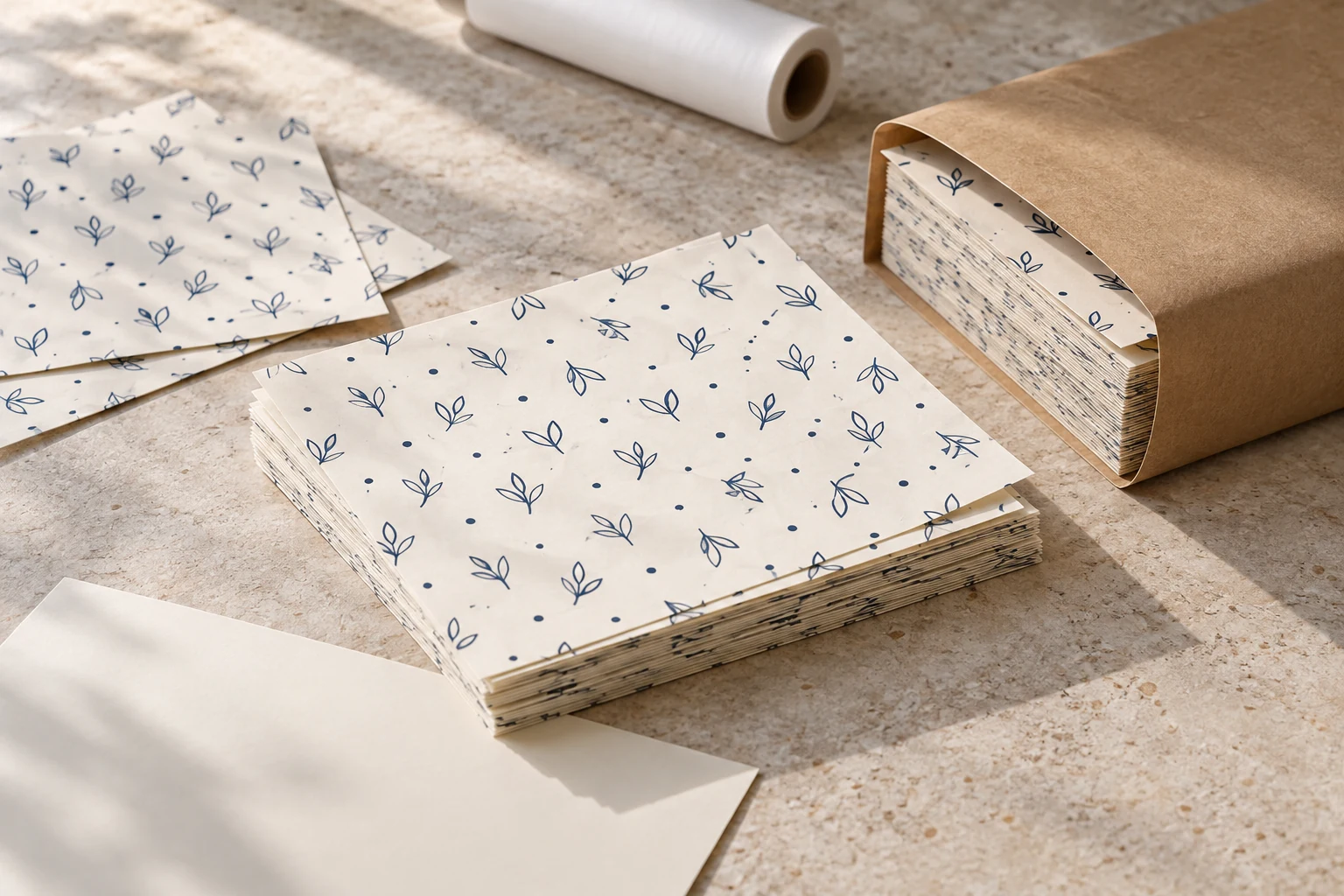
Custom printed parchment paper. From print brief to finished supply.
BakewareLink coordinates custom paper projects for bakery brands, foodservice buyers and distributors. Define the paper’s job, choose the finished format, and approve the artwork on the construction you intend to buy. Sheets, rolls and selling packs are specified together for quotation and repeat supply.
Paper & use · Sheet or roll format · Repeat or registered print · Bulk & retail packing
Print and format concept illustration with an original pattern. Final material, print and use conditions belong to the approved product specification.
01 / Define the product
The paper’s job determines the construction to approve.
Custom printed parchment paper is a finished-paper project: material, print, converting and packing under one specification. A logo is only one input. The first decision is whether the paper will enter an oven, wrap a food item after cooking, line a serving basket or become a retail baking product.
Describe that task in practical terms. Record the food, contact area, time and temperature, then identify where printing appears. Paper color and a grease-resistant appearance cannot make that decision for you.
01
Bakery production
A liner for the baking cycle
Define the tray or mold, recipe, oven type, operating temperature and time. Establish the selected finished construction and release requirement before specifying printing.
Approval focus
Approve the paper, coating and any print together for the stated use. Keep a plain qualified liner with a branded outer pack as a separate project option.
02
Foodservice presentation
A wrap or serving liner
Define the food, oil and moisture exposure, service temperature and contact time. Check the wrap around the actual item or inside the serving basket.
Approval focus
Review the visible print after folding, grease holdout, tearing, handling and the finished contact arrangement. This route does not establish oven suitability.
03
Retail & distribution
A counted pack or dispensing roll
Start with the product use, then define the selling unit: sheets per pack, roll dimensions, dispenser construction, instructions and buyer-provided codes.
Approval focus
Approve paper and packaging as one delivered SKU. A pack design alone cannot establish the paper’s material or operating limits.
Read beyond the product name
Specify the base paper and the finished surface.
Identify the base paper, coating or grease barrier, treated sides, white or natural appearance and basis weight. State whether gsm describes the base paper or the finished sheet. Two 40 gsm descriptions are not equivalent if one excludes an added coating and the other includes it.
For baking, identify the release face and the finished product’s written use limits. For wrapping, define the required holdout during the actual service period and check the folds and handling. Keep print suitability and product suitability within the same review.
Plain-paper format detail. A photograph does not establish coating, basis weight or oven conditions.
Printed food wrap and printed oven liners need separate approval. An unprinted parchment specification does not qualify every ink and print arrangement added to it. When the branding belongs mainly at the point of sale, specify a suitable plain liner inside a branded sleeve, carton or dispenser.
A tray liner needs a finished outline. A wrapping station needs a sheet that folds around the food. A retail roll needs to fit its box and unwind in the intended direction. Select the format against that workflow, then state the dimensions and supply count.
For a baking tray, measure the usable interior base rather than relying on the outside rim dimensions. For a wrap, trial the folds around the actual item, including overlap and the panel the customer will see.
Converting inputs for a complete paper quotation
Supply format
Put in the specification
Check on the sample
Flat sheets
Finished length and width in millimeters, dimensional tolerance, corners, sheets per inner and stack direction.
Check tray-base fit or wrapping overlap. Review the cut boundary against the artwork and confirm that sheets separate cleanly at the work station.
Continuous or perforated rolls
Usable width, roll length, core inside diameter, maximum outside diameter, winding direction and any perforation pitch.
Check dispenser fit, unwind direction, tear or cut behavior and the design visible after the user chooses a cutting length.
Shaped or die-cut liners
Dimensioned outline, corner radius, diameter where relevant, openings, perforation pattern and drawing revision.
Check the actual tray, mold or support. Keep hole position and print position on separate drawing layers and review the finished converted sample.
Interfolded dispenser sheets
Open sheet dimensions, folded dimensions, fold arrangement, count, pack orientation and dispenser opening.
Check one-sheet pull-out, unfolding and the visible print panel. Test a full pack and the last sheets, rather than judging an empty box.
Set cutting tolerances with the proposed converting route and the actual fit requirement. A tight tray fit, a die-cut circle and a hand-cut food wrap have different acceptance needs. Record the measurement method so a later inspection uses the same edges and dimensions.
Perforations also need a function in the brief. A roll tear line, a vented tray liner and holes for a steaming support are different designs. Show pitch, hole size and location; approve them on the intended support. Do not add openings to a design solely because another paper format uses them.
Decide where the design lands after cutting and folding.
A continuous repeat and a logo positioned on every sheet are different print briefs. In a continuous pattern, the cutter can divide the repeat at different points. A centered logo needs the print and cut positions coordinated to an agreed tolerance.
Show the artwork inside the finished sheet boundary. For a folded wrap, mark the outward-facing panel and the fold lines on a separate technical layer. Judge the presentation after wrapping, not only on the flat sheet.
Original layout diagram. Repeat, cut position and registration tolerances are defined in the project drawing.
Choose the print layout
Approve the edge behavior, too.
For repeating patterns, decide whether partial motifs at the cut edge are acceptable. For registered designs, specify the distance from the finished edges and the allowable position variation.
A repeat length is not automatically a finished sheet length. Keep both dimensions in the drawing. For rolls, show which way the design reads when unrolled and after the customer cuts a usable piece.
Supply a usable artwork package.
Send editable vector files, outlined fonts and color references. Include repeat width and length, orientation, print coverage, required margins and the artwork revision. Identify one-color, two-color or full-color requirements explicitly.
Separate cutting lines, folds and annotations from printable content. Check spelling, addresses and any buyer-provided codes before the file becomes the approved production revision.
Confirm print side and contact arrangement.
Identify the food-facing and outward-facing sides in the flat sheet, the folded wrap and the packed stack or wound roll. Do not rely on a product photograph to define those relationships.
Review the selected paper, coating and printing as a finished configuration. During sample handling, check for visible marking, rub-off or transfer between contacting surfaces and record the result.
Use a physical print sample for color decisions. A screen image or digital proof can establish the file content, but it does not show the exact color and detail on the chosen paper. Paper shade, surface and print coverage belong in that approval. Keep a labeled retained sample for subsequent production comparisons.
04 / Sample approval
Approve the finished paper, then the delivered pack.
Set the acceptance criteria before ordering a custom proof or sample. A plain material sample answers a different question from a print trial, and neither automatically represents the final converted and packed product.
Label each sample with the paper construction, print scope, dimensions and file revision it represents. If the final process is not represented, record the remaining check and the approval needed before bulk production.
Five approval records for the finished SKU
Approval stage
Review
Record before release
Specification & documents
Paper construction, coating or barrier, declared gsm basis, intended use, print arrangement and the required destination-market records.
The selected construction and use conditions are identified; document coverage matches the proposed finished product.
Artwork & physical print
Content, spelling, color, coverage, fine details, repeat spacing, margins, print side and fold orientation.
The approved file revision and physical print sample are recorded together. Any agreed variation is stated in writing.
Converting & handling
Sheet outline, roll width and length basis, core, perforations, cutting registration, stack or winding direction and dispensing.
Finished dimensions and functional checks meet the agreed criteria on the actual support or dispenser.
Intended-use trial
Actual food, contact time, grease or moisture exposure, handling and release; stated oven cycle where baking is intended.
The relevant material review and practical trial are complete. A successful appearance check is not treated as proof of all food-contact requirements.
Packed unit & identification
Count, inner protection, retail or dispenser pack, instructions, codes, carton configuration and lot identification.
The delivered unit matches the quotation and the approved SKU record, including the packaging revision.
Make the practical trial repeatable.
Use the actual recipe or served food, the actual tray or dispenser, and the stated contact conditions. Record the sample identity, date, operator, conditions and outcome. For a wrap, assess fold retention, handling and grease or moisture marks over the intended service period. For a baking liner, record the agreed oven cycle and release result.
A trial can reveal a handling or performance problem; it does not replace the required finished-product documentation. Specify which records are needed for the destination market and ensure they identify the selected paper, coating and print scope. Keep promotional claims off the pack until their supporting records are approved.
Agree who approves artwork, product performance and packaging. One contact can coordinate the project, but the signed record still needs to identify each approved item. A late change to a print file, base paper or pack count must be reviewed before production continues.
05 / Quantity, MOQ & quotation
Keep sheets, kilograms and selling packs distinct.
A paper order can be quoted by weight while a bakery consumes sheets and a retailer sells packs. State all three where relevant, then identify the contractual delivery unit. Keep net paper weight, packaging weight and carton gross weight in separate fields.
Split the requirement by paper construction, finished format, artwork and packaging. A total quantity across several designs does not establish the minimum for each design or pack.
These counts are an illustration. The quotation must identify the confirmed inner pack, carton count and any allowed count variation for the selected SKU.
Nominal mass example
Use a declared gsm basis.
0.30 m × 0.30 m × 40 g/m²3.6 g / sheet1,000 sheets × 3.6 g3.6 kg of paper
This example assumes 40 gsm describes the finished paper. If it describes only the base paper, additional layers are outside the estimate. Packaging is excluded; confirm counts and weight tolerances separately.
Separate print and converting costs.
Ask the quotation to identify print setup, plates where used, cutting tooling, custom proofs and sample charges. State who retains artwork and tooling records, whether a setup charge recurs, and how a changed design is handled.
MOQ belongs to a defined configuration. Review minimums for the paper, each print design, converting format and printed pack materials. Compare the same scope before choosing a price.
Build timing around the approvals.
Identify the dates for material selection, artwork approval, physical proof, intended-use review and pack approval. Confirm what starts the production schedule and which materials must be ready at that point.
Include inspection, packing and transport in the required arrival date. Keep first-order development separate from the expected timing for an unchanged repeat order.
For rolls, compare the same width and usable length, core, winding and packing. A lower price per roll is not a useful comparison if the roll is narrower or shorter. For retail packs, compare the same sheet count and dimensions, then include box, sleeve, dispenser and outer-carton costs.
Keep the approved specification with every reorder.
Specify paper orientation, sheets per inner, inners per carton or rolls per carton. Confirm the protection needed to keep stacks flat, edges clean and rolls supported during storage and transport. Identify the SKU and lot on the delivered units.
For retail supply, approve the dispensing box or counted pack with the actual paper inside. Review opening, withdrawal, refill where relevant, instructions, languages and buyer-provided codes as a complete selling unit.
Control the pack contents.
Define whether one pack contains a single design or several designs, and state the count of each. Keep the retail count distinct from the inner shipping count. Trial the full dispenser, its paper orientation and its last usable sheets or roll length.
Store unopened paper in clean, dry conditions according to the selected product’s instructions. Keep cartons away from moisture and strong odors, and protect opened packs at the work station.
Retain one SKU approval file.
Keep the paper and coating specification, use conditions, artwork, physical print sample, cutting drawing, roll or sheet dimensions, approved documents and packing record together. Add the first delivered lot and any trial feedback.
Review changes to paper, coating, inks, layout, converting or packaging before repeating the order. A similar-looking sheet is not a substitute for the approved configuration.
Give replenishment forecasts by SKU rather than one undivided paper quantity. For mixed orders of paper, mats, pans or packaging, coordinate readiness, carton markings and packing lists so each delivered item can be reconciled to its own specification and count.
Send the use, the format and the artwork together.
Include food and contact conditions, paper and coating requirements, sheet dimensions or roll specification, print side and layout, quantities per variant, pack counts, destination and required arrival. Identify the sample checks and documents needed for approval.
Custom printed parchment paper combines a specified paper construction, artwork, finished sheet or roll format and packing configuration. BakewareLink coordinates the project from the intended use through quotation and sample approval. Baking liners and branded food wraps follow separate material and use specifications.
Can custom printed parchment paper be used in an oven?
Use printed paper in an oven only when the selected finished paper, coating and print system are confirmed for the stated baking conditions. Record the oven type, temperature, duration, food and contact arrangement. The heat limit of an unprinted base paper does not establish the suitability of the printed version.
Is printed greaseproof paper the same as baking parchment?
No. Printed greaseproof paper is selected for wrapping, serving and food presentation. Baking parchment is selected for a defined baking and release task. White or brown color, grease resistance and paper weight do not establish that a food wrap is suitable as an oven liner.
Can a logo be centered on every sheet?
A logo centered on each sheet needs a registered print-and-cut layout with an agreed position tolerance. A continuous repeat pattern can be cut through different parts of the design. State which layout you require, show the finished sheet boundary and approve the physical cut sample.
What artwork should I provide?
Provide editable vector artwork, outlined fonts, color references, repeat dimensions, print direction, coverage and margins. Identify the print side, visible panel after folding, artwork revision and whether cutting is registered to the design. Keep printable artwork separate from dimension and cutting annotations.
Can the paper be supplied as sheets, rolls or shaped liners?
Specify flat-sheet dimensions and count, or roll width, length, core and winding direction. Shaped liners need a dimensioned outline, corner details and any hole or perforation pattern. Interfolded packs need a fold layout and dispensing check. Format feasibility, tooling and minimums are reviewed for the chosen construction.
What is the MOQ for custom printed paper?
The quotation states the minimum for each paper construction, format, artwork, color arrangement and pack configuration. Printing, converting and retail packaging can have separate minimums. Specify quantities per variant and identify whether the order basis is sheets, rolls, packs or kilograms.
Is an artwork proof enough to approve the order?
No. A digital proof establishes artwork content and layout. A physical print sample establishes appearance on the selected paper. A production-intent converted sample is needed to check cutting, handling, intended use and packing. Keep these approvals separate and record what each sample represents.
How do I compare a kilogram quote with a sheet quote?
Use the same finished dimensions, paper construction, print scope and packing basis. For a 300 × 300 mm sheet at a declared finished basis weight of 40 gsm, the nominal paper mass is 3.6 g per sheet. This calculation excludes packaging and is a planning estimate; the quotation must still state finished counts, weight tolerances and delivery units.
What should be retained for repeat orders?
Retain the approved paper and coating specification, intended-use conditions, artwork revision, physical color and print sample, cutting drawing, finished dimensions, packing counts and product documents under one SKU. Review any change to paper, print, format, use or packaging before issuing a repeat order.
Project discussion
Start with a clear buying brief.
For an oven liner, include the actual baking cycle. For a wrap, show the folds and visible panel. For a retail program, specify the delivered pack count or roll dimensions. Mark any material or format decisions that still need a proposal.
Send your product references, intended use, quantities and destination. Include pack or brand requirements so the quotation covers the unit you intend to buy.